How did you become who you are? Were you born with the abilities you now take pride in? I suspect not. I certainly wasn’t.
Right now, a generation is coming through without those same opportunities. Youth unemployment is rising sharply, entry-level jobs are disappearing, and the pipeline that used to carry young people into meaningful work is narrowing at both ends.
The Scale of the Problem
With youth unemployment in the UK sitting at 15.8%, 713,000 young people are stepping into adulthood without the hope that previous generations have had. This is not a blip. Since youth unemployment hit a post-pandemic low of 9.2% in 2022, it has risen sharply and is now approaching levels not seen since the aftermath of the 2008 financial crisis.
And the problem isn’t just unemployment. The jobs simply aren’t there. Vacancies for entry-level roles, graduate positions, apprenticeships, internships, and junior jobs, have dropped 32% since November 2022, correlating precisely with the widespread adoption of AI tools. More than 1.2 million applications were submitted for just 17,000 graduate roles in the UK last year. The pipeline is being squeezed from both ends.
This will be further compounded for Gen Alpha. The loss of paper rounds, Saturday jobs and casual work, those first, formative encounters with the world of work, leaves an ever-decreasing circle of opportunity for our children to develop the life skills that allow them to flourish in the workplace.
Greater Manchester Is Starting to Act
We hear a great deal about the markers of decline, but far less about the solutions. Greater Manchester’s institutions, however, are starting to make real, positive steps in addressing these challenges.
The Local Skills Improvement Plan (LSIP), led by the Chamber of Commerce and the Greater Manchester Combined Authority, has brought together employer experiences and needs and dovetailed them with Higher Education provision. This has coincided with GM being selected as a National Trailblazer for the Government’s employment reforms, a designation that should deliver a material improvement in job prospects for young people across the city region.
T-Levels sit at the core of filling the training gap. They give young people practical experience of the workplace while providing the underpinning theoretical knowledge to support them in their chosen role. The intention is that on completion, students are equipped with work-ready skills that allow them to transition directly into employment.
How It’s Worked at NTB Survey
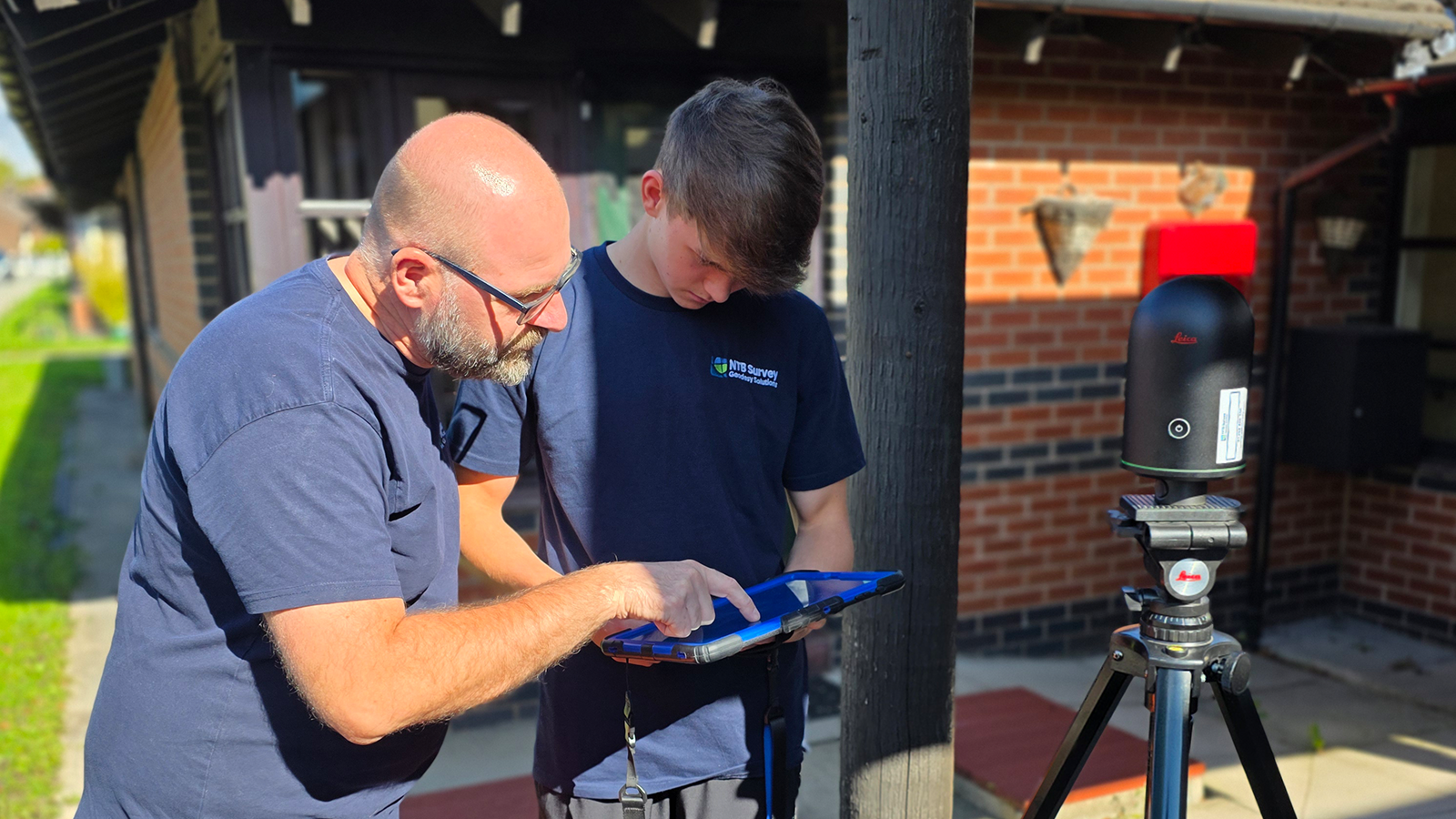
Which is exactly how we have found it to work at NTB Survey. As a small business, offering a T-Level placement was daunting. The reallocation of resources to make sure that whoever came to us got the most out of it, whilst also ensuring NTB benefitted, required real thought and commitment. I’m pleased to say it has been worth every bit of it. The student we took on has now been offered a full-time apprenticeship role at NTB Survey, where we have gained a valuable member of the team.
This is only part of the story, though. Whilst Higher Education Institutions do a fantastic job in challenging circumstances, little can beat sitting in a van with a surveyor who has over 20 years’ experience, talking through control networks and the practicalities of station positions on a real, live job, whilst you crunch on a bag of cheese and onion crisps as the rain pelts the windscreen.
Learning through osmosis has been one of the most enriching parts of my career, be that the patience shown to me by my own mentors, with tales of coconut hunting in the Caribbean (whilst waiting to make a bearing observation, land surveying was a little different in the 1970s!), through to atmospheric pressure and the adjustments needed on instruments to account for it. All whilst sat in a van on any given Tuesday.
It is this kind of learning that NTB champions and actively encourages. Asking questions and not knowing the answers is accepted as the norm, not the exception, because there will always be someone in the business who has the solution.
A Call to Employers
NTB is not alone in this. There is a wealth of employers out there who, if they took the risk and engaged, would be able to give purpose to the upcoming generation and add genuine value to young people’s lives. More needs to be done to help employers take that risk without it being to their detriment. But equally, employers need to lean into the challenge and take those risks themselves.
The School’s Role and Ours as an Industry
As a Link Governor at Darwen Aldridge Community Academy (DACA), I am particularly conscious of combating the challenges that are impacting Gen Z, and that will soon be experienced by Gen Alpha. More needs to be done by secondary education to speak to business and invite employers into schools, to open pupils’ eyes to what career options exist, the sense of fulfilment that comes from a job well done, and to inspire the next generation.
But business also needs to engage. We need to afford time to go into schools, be present, and lay out what it’s actually like to work in our respective industries. Not just because it makes good content for social media, but because we believe in supporting the next set of surveyors, project managers and piling engineers.
We all have a social responsibility to help improve the lives of the generations that follow.
What This Means for NTB
If you’d like to come into Darwen Aldridge Community Academy (DACA) and inspire our pupils, drop us an email at info@ntbsurvey.com and we’ll get you in front of potentially your future employees.